
Schools defy Government education reforms

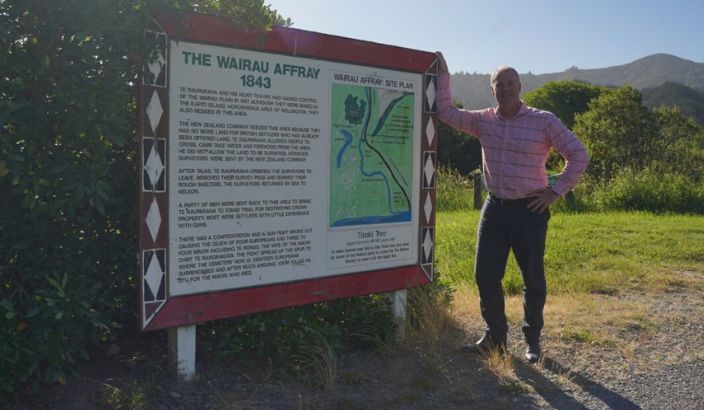
Tua Marina School principal Nic Walker at the site of 1843’s Wairau Affray, which he points to as proof TeTiriti has been key to Marlborough education since his school’s 1871 founding. Photo: William Woodworth.
Eleven of Marlborough’s 30 schools have joined more than 1000 nationwide in defying the Government’s education law changes.
Marlborough Boys’ College, Marlborough Girls’ College, Queen Charlotte College, and Redwoodtown, Renwick, Spring Creek, Springlands, St Mary’s, Tua Marina, Waikawa Bay, and Whitney Street Schools have announced they will continue acknowledging Te Tiriti o Waitangi, despite the newly passed Education and Training Amendment Act 2025.
Local educators say they are concerned about the removal of Te Tiriti from the curriculum and school board obligations without public consultation, uncertainty around NCEA qualifications, and the loss of Teaching Council independence under new ministerial oversight.
In an open letter to Education Minister Erica Stanford, Marlborough Girls’ College principal Mary-Jeanne Lynch outlined her concerns.
“While our Board and staff are committed to continuing our partnership with iwi and to honouring Te Tiriti, our concern is that this legislation, as well as other changes in education, will have a negative impact on our young people and the future of our society,” she writes.
“Without transparent and open consultation with all of us who are charged with educating our young people, I am left with nothing else to explain what is happening to our education system.
“We are not aware of the rationale for these significant and rapid changes – one can only assume they are the outcome of a manufactured rhetoric that education in Aotearoa New Zealand is in crisis (it isn’t) and teachers and principals are not to be trusted (our community does, every day).
“Our teachers are upset at the lack of acknowledgement of a broad view of learning and success along with the lack of real-world, authentic contexts in the new curriculum.
“In the new curriculum, capabilities are a sidebar and suggested English texts are very Euro-centric and predominantly written by male authors. Where are our ākonga represented in this new curriculum?
“The changes happening in education are designed to undermine our philosophy, direction and hard mahi over the last eight years … we believe they will have a detrimental impact on our community and our future as Aotearoa New Zealand.”
Tua Marina School principal Nic Walker says their history has always been intertwined with Te Tiriti principles.
“Our school was founded for our community to heal after the breach of Te Tiriti at the events of the Wairau Affray in 1843, three years to the day of the signing at Port Underwood,” Nic says.
“Honouring Te Tiriti has been a part of Tua Marina and wider Marlborough education since at least our founding in 1871, and this decision won’t stop that.”
Spring Creek principal Cheryl Alderlieste and board presiding member Cara McGregor say, “Our ongoing commitments to Te Tiriti o Waitangi are embedded in our strategic plan and will continue to be reflected in all areas of school planning and practice.”
Waikawa Bay School’s Board of Trustees says the principles of Te Tiriti “guide how we teach, how we lead, and how we build relationships with our tamariki, whānau and wider community.
“It reminds us of the importance of partnership, protection and participation – values that help ensure all ākonga feel seen, valued and supported to succeed as themselves.”
St Mary’s School board presiding member Charlotte Alford writes, “As a Catholic school, our faith calls us to uphold the dignity of every person and to walk together in the spirit of love, respect, and justice.
“Our School Board stands firmly in support of remaining true to these commitments, which reflect both our Gospel values and the principles of Te Tiriti.”
Queen Charlotte College Board member Megan Bruce adds, “Our unanimous commitment to honouring Te Tiriti remains unchanged. While the legislation has changed, Queen Charlotte College’s commitment to inclusive, culturally grounded education and upholding Te Tiriti o Waitangi has not.”