
Look! Up in the sky! Electric plane making test runs at Marlborough Airport
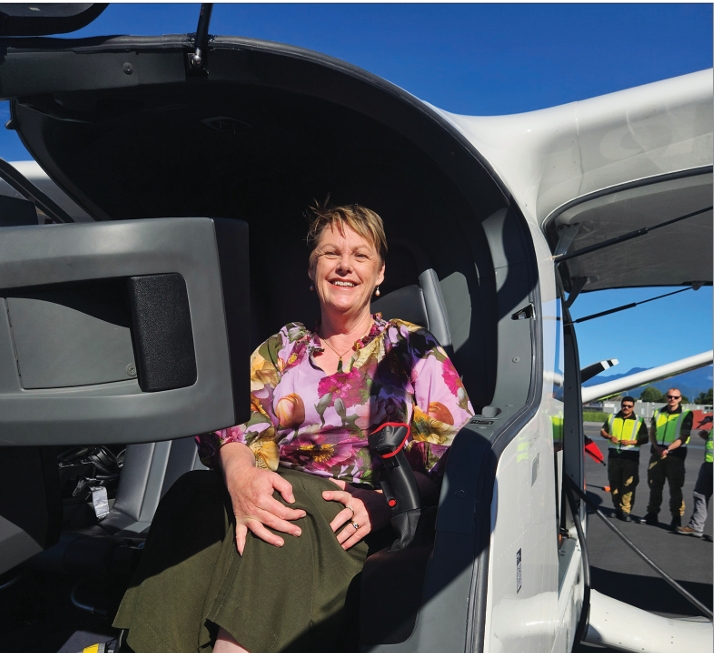
Marlborough Mayor Nadine Taylor tries out the cockpit of the BETA ALIA CX300 electric aircraft during a stopover in Blenheim last Wednesday morning. Photo: Evan Tuchinsky
James Owen might just have the best job in Kiwi aviation. His title is Standards and Training Project Pilot for Air New Zealand’s Next Gen Aircraft Programme. His day to-day is taking to the skies in cutting-edge planes which represent the future of the fleet.
His current focus – the BETA ALIA CX300, the first electric plane with Air NZ’s name on it – has Marlborough Airport as a testing ground. Co-piloting with visitors from U.S.-based aerospace company BETA Technologies, James is shuttling between Wellington and Blenheim to gauge how the plane handles Cook Strait’s conditions.
The flights started last week and will continue on a daily basis – sometimes, multiple times a day – over the next several weeks. The BETA ALIA CX300 is in the validation phase ahead of receiving certification.
“Essentially what we’re doing here is testing the aircraft’s capabilities in the New Zealand environment,” James said last Wednesday, with the plane just over his shoulder on the Blenheim tarmac. “How does it integrate with existing airports, with airspace, with other airspace users? What do we need to upgrade in terms of charging infrastructure?
“The physics behind the airplane are the same as any other plane,” he added. “It flies just like any other aircraft.” That said, James knows how turbulence over the strait creates a distinct challenge, having learned to fly in Wellington.
“The [BETA] plane weighs all up 3.2 tonnes,” James explained, “and most of the weight is in the belly of the aircraft. So, I think it’s got a self-righting characteristic that makes it a very stable and very comfortable aircraft to fly in.”
Touching down locally
Once the plane passes certification, Air NZ plans to utilise it initially for cargo. Passenger travel could follow, James indicated, with commuter flights between smaller airports such as Marlborough holding potential.
Last Wednesday morning, James and Ben Swain from BETA landed at Marlborough Airport, taxied to a hangar, plugged in for a recharge and guided a dozen observers around the craft.
Mayor Nadine Taylor climbed into the cockpit and learned about its features from James; moments earlier, Councillor Brian Dawson’s son Alex, a pilot, enjoyed the same vantage and a primer from Ben.
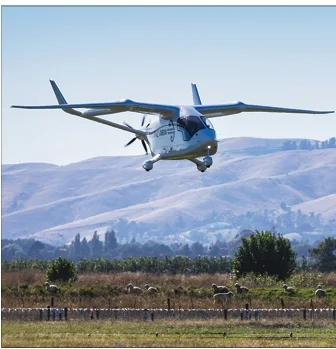
“It’s great to see that Marlborough is part of this project and that we were included in the opportunity to have the electric plane fly into Marlborough Airport,” said Brian, who serves with the mayor on the airport’s board of directors. “It’s incredible to see the aircraft now up close. It almost resembles more a helicopter than a plane if you ignore the wings. It’s good to see a more sustainable option being developed in aviation and to see that in action.”
Ben, like James, see the BETA ALIA CX300 as fundamentally similar to familiar aircraft. One of BETA’s three current models can take off vertically, like a helicopter or harrier jet.
“If you take the batteries and the motor off of this thing, there’s not much difference technology-wise from other airplanes that are out there flying,” he said. “We’ve got a full fly-by-wire flight-control system; it’s got a wing, it’s got a tail, it’s got wheels.
“We tried to make it as simple as we possibly can for safety and reliability. Carrying all this extra weight with the batteries, we’re trying to make everything as efficient as light as possible. There’s no reason to make it more complicated than it needs to be."