
Seaweed boosts soil health and slashes fertiliser bills for Marlborough farmer
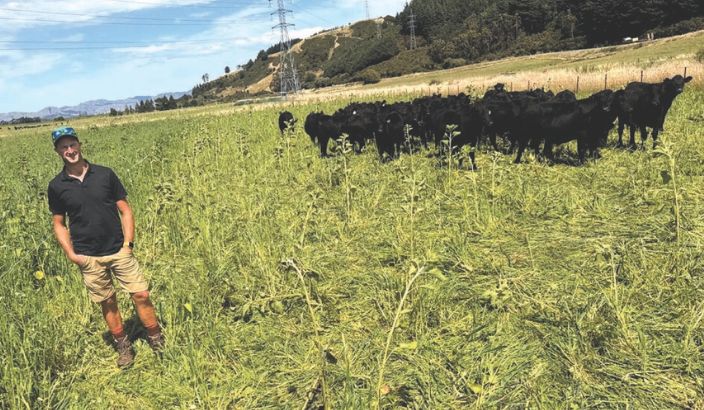
Kaituna farmer Bryce McIntyre has halved his fertiliser spend after shifting to a soil‑first system supported by seaweed biostimulants. Photo: Supplied.
Seaweed has long played a role in New Zealand agriculture, well before it became a commercial product. Māori used native seaweeds (rimurimu) for cultural, spiritual and practical purposes, including soil conditioning and food production.
Commercial use began in the 1970s and 1980s with liquid seaweed extracts marketed as fertilisers. A bigger shift came in the mid-1990s when companies such as AgriSea started producing seaweed-based soil and plant health biostimulants at scale. Kiwifruit growers were early adopters, followed by wine grape producers and dairy farmers.
Today, seaweed remains an emerging industry. AgriSea’s raw seaweed is sustainably collected from beach-cast material and processed using a cold, chemical-free extraction method to produce agricultural and horticultural products such as soil biostimulants and animal feed supplements. More recently, research into other seaweed species has shown promise as livestock feed additives to help reduce methane emissions, attracting growing interest in the sector.
For Kaituna, Marlborough farmer Bryce McIntyre, seaweed products have become central to his farming system. Bryce runs a high-intensity cattle block alongside a vineyard and says his shift began four to five years ago when he started addressing underlying soil issues rather than focusing solely on plant performance.
While Bryce says the cost to implement and maintain his ongoing pasture programme differs each year he estimates that from when he changed the way he was doing things with traditional fertiliser to now his annual fert spend is around half what is used to be.
“I wanted to focus on soil health and what was productively available for the plant, by treating the soil” he says.
Bryce says he has not applied conventional pelletised fertiliser since making the change but is quick to point out that his success has not just been solely because of using seaweed biostimulants. “I have an ongoing pasture programme and a grazing management plan – the combo works really well,” he says. He adds that initially he had a bit more of a focus on instant gratification with finishing products, and over time that morphed into soil type products for both his pasture and vineyard.
His stocking rates reflect his planning and product use success. “I’m running 360 R2 steers on 100 hectares, of which 60 hectares of flat gets seaweed and makes up the engine room of the operation,” he says. “My stocking rates are a testament to the good combination I’m using. I’ve got more cattle than I’ve ever had and more feed than I’ve ever had.”
Farming in Marlborough can get very dry. Bryce says they are not in an overly dry area, although compared with other parts of the South Island, many would still consider it dry. He says improved soil condition has helped buffer seasonal variability. “We find that the seaweed makes the pasture very resilient through dry patches,” Bryce explains. “The weather is unpredictable, so for me, successful farming comes down to pasture.”
Cost was a driver. During Covid-19, when fertiliser prices spiked, Bryce sought a long-term solution. He now spends about half as much on fertiliser. “This is sprayed on with the tractor and is instantly available to the plant,” he says. “Every year it seems to get better and better – improved soil and plant health year on year.”
Rhys Hikuroa from AgriSea- a family-owned seaweed company- says Bryce’s experience is increasingly common. AgriSea sources most of its seaweed from the North Island, where about 100 pickers collect beach-cast seaweed that is washed, dried and graded.
“We’re seeing gains nationwide from farmers and growers using a mix of conventional fertiliser and biostimulants,” Rhys says.
He says soil and herbage testing is critical. “Every farm is different. Testing gives you the insights needed to make decisions for your own farm and situation.”
With growing pressure to reduce nutrient inputs, Rhys says healthy soil microbiology is key. “Looking after microbial populations means they can supply a meaningful proportion of a crop’s nutrient needs. That not only saves on fertiliser spend, it can also help farmers meet regulatory requirements to apply less nitrogen fertiliser.”
Seaweed isn’t a silver bullet, but as part of a wider soil-focused system, it’s proving to be a powerful tool. Based on Bryce’s experience, it could be worth exploring for your own operation.