
Sea-rise flooding forecast shifts for Lower Wairau

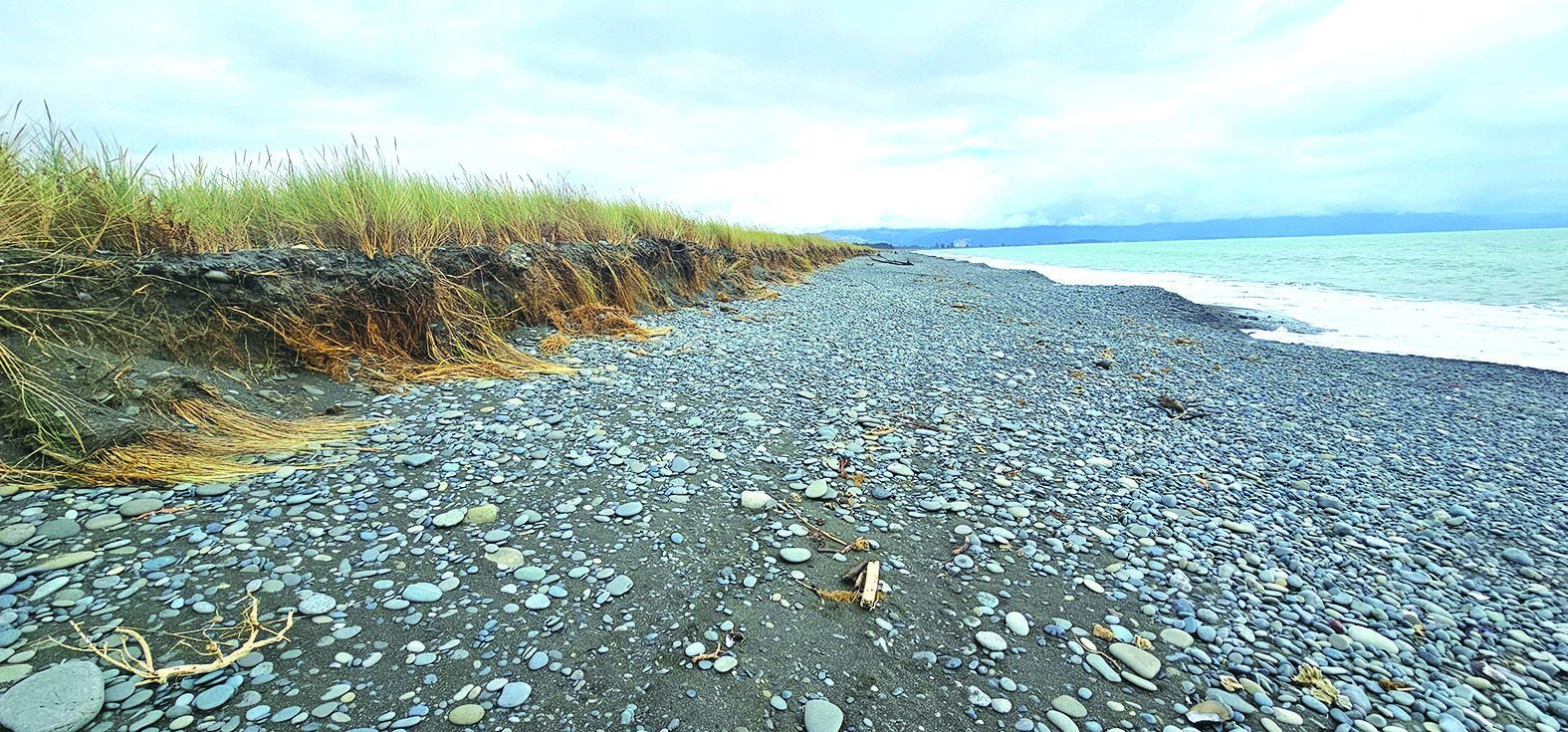
Along the Lower Wairau coastline, new modelling of sea-level rise predicts that existing flood protection infrastructure will keep the sea at bay better than previously believed. Photo: Supplied.
KIRA CARRINGTON, Local Democracy Reporter
The impacts of sea-level rise on Marlborough’s Lower Wairau Plain near Blenheim could be less serious than originally predicted, new modelling suggests.
New sea level and flood mapping by Earth Science New Zealand (formerly Niwa) had come at “exactly the right time for us to reassure the community”, Marlborough District Councillor Gerald Hope said at the presentation to the environment and planning committee last Thursday.
Council head of environmental policy Pere Hawes told councillors that the new dynamic modelling was far more accurate at predicting the impacts of climate change than the “bathtub” modelling conducted in 2023.
“[The bathtub model] was simply if the land is at this level and sea level rises at another level then that [land] will be inundated,” he explained. “It didn’t take into account, for example, links or barriers to the water getting to that land ... particularly in terms of [how] river management and flood management would have an influence.”
The new modelling should be publicly available on Council’s SmartMaps website (smartmaps.marlborough.govt.nz) on May 14.
Dr Scott Stephens, Earth Science New Zealand coastal hazards scientist, said two models had been developed: one that predicted average sea-level rise, and one that predicted the effects of rising sea levels on storm flooding.
The storm model found that, even with increased sea levels, current flood protection infrastructure would keep storm flooding more localised to river areas than previously thought, he said. However, the flood protection would not hold indefinitely.
While flooding could be less severe than initially predicted, Stephens said there were still sections of the plain that would become underwater.
“We found that the central and southern coastal sections of the wider plain are most sensitive,” the scientist said, adding that critical infrastructure like the Blenheim Sewerage Treatment Plant, located near the Wairau Lagoons Walkway, would be “in the sea in the future”.
Discussion
Andy White, Council’s rivers and drainage engineering manager, said the modelling proved how critical stop banks, such as the one being rebuilt at Spring Creek, were for the protection of communities.
“The work we’re doing at Spring Creek is obviously not just about how flood protection is going to be needed for coastal protection in the future ... and that was a factor in that design work that we did,” he explained.
Mayor Nadine Taylor asked how the improved modelling would impact insurance retreat. AA Insurance, for example, had stopped offering insurance to homes in some flood-prone areas to reduce the company’s risk exposure.
Jaime Sigmund, the council’s strategic planner, said he had met with an insurance company and found they had “little regard to Council-held data” as they conducted their own risk assessments. But the modelling would be publicly available, and insurers would be free to use it.
Councillor Hope said the new modelling was “the most compelling, powerful modelling that we’ve probably had presented to us” and added, “I’m reassured; that’s the message I got from the report.”
Councillor Malcolm Taylor noted that land uplift, in the aftermath of an earthquake, could have an impact on modelling predictions. The 7.8-magnitude earthquake in 2016 lifted several rugby pitch-size areas along the Kaikōura coast up to 6m out of the sea.
Stephens said that naturally there would be changes to the coastline over the next 100 years, but such events would be difficult to predict and so were not modelled.
Rural representative Simon Harvey said he understood that the faultline running up the Awatere Valley was “overdue for a massive earthquake”, and asked Stephens what impact that could have on land uplift. Stephens said he didn’t know but would ask his colleagues.
LDR is local body journalism co-funded by RNZ and NZ On Air.