
Dental closure in Marlborough shines light on shifting times
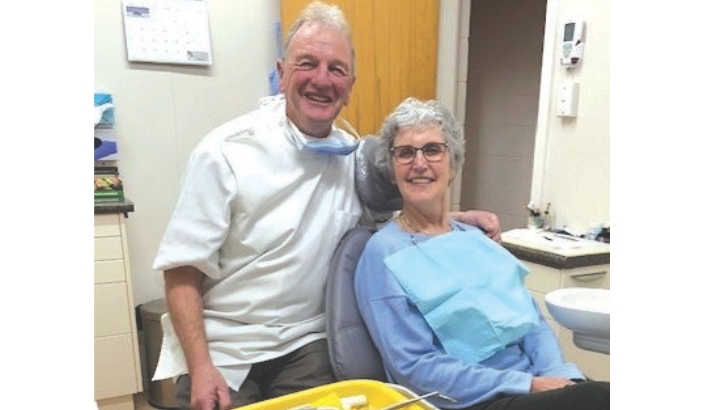
Dr John Beattie and his wife, Elspeth, pose in his surgery during the dental practice’s transition to closure. Photo: Supplied.
Medical and dental practices are businesses. Practitioners are managers, if not also owners. Patients are customers as well as neighbours needing care. Financial records demand scrutiny like health records. Technology and innovations retool operations.
For 45 years, Dr John Beattie juggled these responsibilities at his dentistry office in Blenheim. He followed his father into the profession – and, subsequently, into private practice in his hometown. John’s patient base grew to 4,000.
Here’s another business element: succession planning. John hoped to retire at age 65, so he “made early plans” to do so – but COVID-19 “really put a cat among the pigeons.” When the pandemic passed, John put his practice on the market.
It sat for sale for two years. Total number of inquiries: one. “The market for selling practices just died completely and still hasn’t really recovered from that event,” John explained. “How long do you hang on waiting for the ideal thing to come along?”
So, earlier this year, John decided to close the Lister Court office his late father, Dr Ron Beattie, opened six decades earlier. Dr Duncan Gilchrist, the office’s other remaining practitioner, moved to another surgery.
What’s happened
The economics principle of supply and demand affects care and commerce alike. John faced that reality of contemporary dentistry.
“The number of graduates coming through is proportionally less than desirable,” he said, “and a lot of the young people are not prepared to take on business risk at an early stage. It’s general throughout the country.
“That’s where the corporate bodies have come in, pitched practices and employed people. Most of those [dentists] only tend to stay short-term and go on to somewhere else. They’re not buying practices.”
John’s wife, Elspeth, retired from her pharmacy career eight years ago. Spending more time with her and family grew increasingly enticing. John and Duncan owned separate practices but put them up for sale together.
Unlike most business owners, whose clientele have a range of options, dentists are increasingly more in demand for what they supply. Pondering closure brought a distinct concern.
“It’s always been in the back of my mind that to walk away would leave 4,000 people without a practitioner,” John relayed. “It troubled me for quite some time. But we’re very fortunate that the other practices in town have been receptive to taking the patients on. As people come due for checkups, it’s a drip feed rather than a sudden flood.”
Retirement itself has been a transition: “At the end of the first week, I wanted to go back to work,” he admitted. “The biggest thing is missing the people contact. In 45 years, I’ve probably seen over 200,000 mouths – those mouths have people contact attached to them. There are some really neat people out there.”