
Marlburians dig into $110m loan for Picton port upgrades

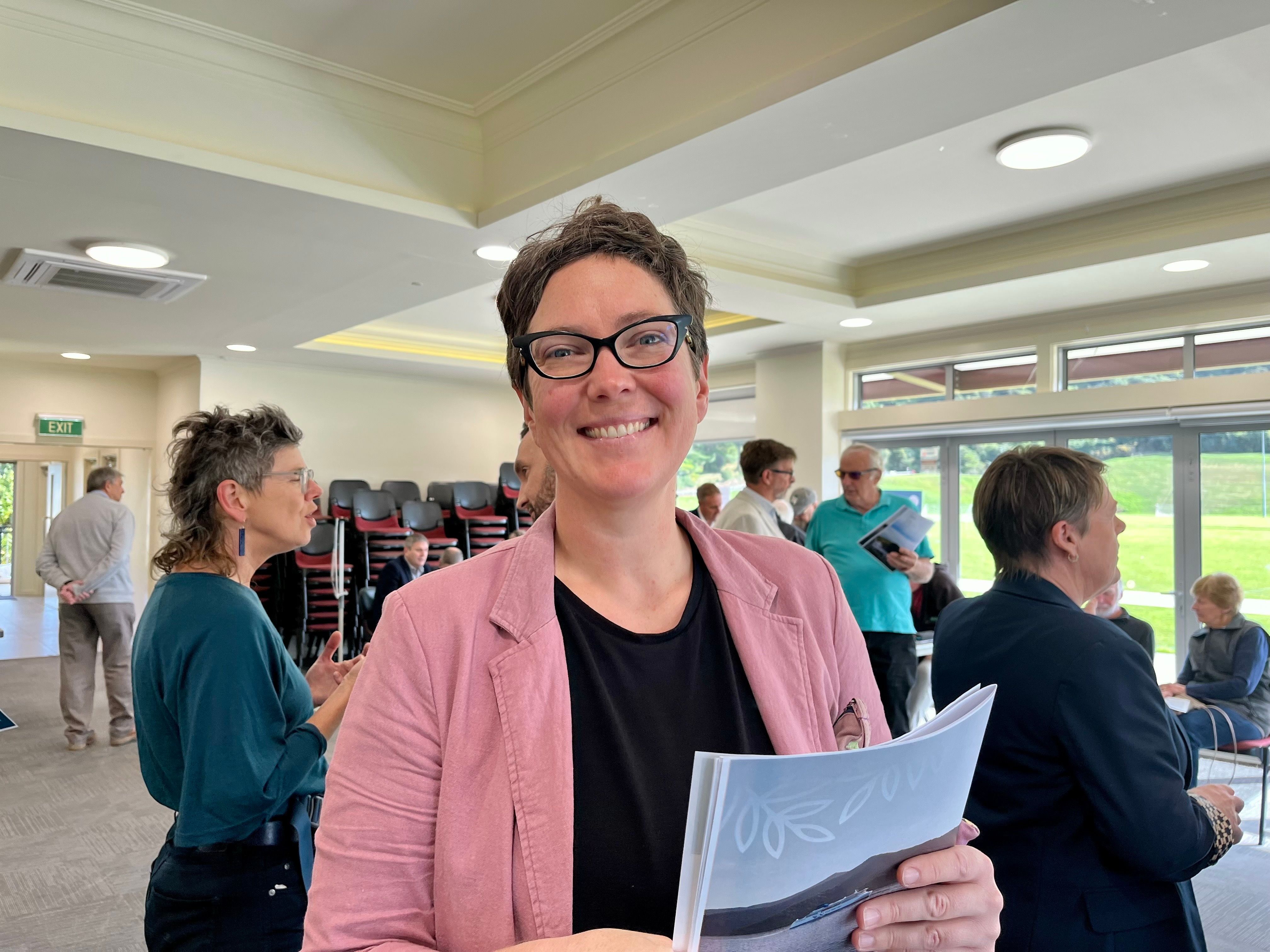
Picton resident Julia Kennedy attends an informational session for the ferry project on 13 May. Photo: Kira Carrington/LDR
By Kira Carrington, Local Democracy Reporter
Marlborough ratepayers have been weighing up the pros and cons of Port Marlborough taking out a $110 million loan to fund port upgrades ahead of new ferries arriving in 2029.
Residents put their questions to staff from the Marlborough District Council, Port Marlborough and Ferry Holdings, and Marlborough Sounds councillors and Mayor Nadine Taylor at two drop-in information sessions on the loan proposal at Port Marlborough Pavilion in Picton on Wednesday.
To prepare the port for the new, larger ferries, the council wanted to borrow $110m from the Local Government Funding Agency and on-lend it to MDC Holdings, Port Marlborough’s parent company.
Port Marlborough would then borrow up to $110m from MDC Holdings, and operation income would service the loan, rather than ratepayers.
The Picton work was expected to cost about $530m in total, and any costs over and above $110m were to be covered by Ferry Holdings.
Picton sessions
Picton resident Julia Kennedy said at one of the sessions she supported the loan but wanted more information.
“My personal sentiment would be that I don't think that the solution goes far enough to resolving future infrastructure needs,” Kennedy said.
“When it comes to decisions about infrastructure, [a] short-term resolution is usually not cost effective. You want an 80-year solution, not a 20-year solution.”
But the current plan was still an investment in the future of Picton, she added.
“I don’t think there’s any argument for not [doing it], like, what are we doing otherwise?”
Picton resident Cliff Bowers spent a long time discussing the loan with council chief financial officer Geoff Blake.
Bowers said his main concern was the impact of the loan on the council’s credit rating.
“[I wanted] to make sure that it didn't ... affect the council's ability to borrow,” Bowers said.
“Because if it affects our credit rating, then our rates go up.”
Blake told Local Democracy Reporting that there were many factors that went into a credit rating, and while he couldn’t control the assessment of credit ratings agency S&P Global, he was confident that the council had secured “a really good deal”.
Bowers’ other question was whether the port taking on the loan would impact the port’s profit margin, which was used to offset rate rises.
Blake said the investment into ferry infrastructure was projected to yield a higher dividend to the people of Marlborough than if the upgrades did not take place.
There was no risk of the loan becoming larger, Blake said.
“[We told Ferry Holdings] we've got $110m that we think we can raise, we want the public to confirm that.”
“$110m was something that, as a council, we were comfortable with last time [with iReX].
Bowers said he thought the government needed to take a long-term view on infrastructure renewal.
While it was too expensive to do all the upgrades at once, as iReX had tried to do, conducting incremental upgrades over the lifespan of the infrastructure would strike a better balance between infrastructure maintenance and fiscal restraint, he said.
“However, with global warming and everything else going on, you’ve got to be careful not to put that out too far.”
Blenheim residents Henry Voordouw and Trish Smith said they felt their main concern went unanswered: “If it goes belly up, what happens?”
“It was kind of like they’d all had lunch yesterday, and all had the same answers,” Smith said.
Port Marlborough planned to service the loan using the service charges that KiwiRail paid for Interislander to use the port. But Voordouw and Smith said they were worried about who would be left holding the bill if the government decided to sell KiwiRail.
“Ultimately they [are putting] your property up as collateral ... and if [it] turtles belly up, it's the ratepayers who are responsible for it. It's a hell of a big debt,” Smith said.
“I didn’t really get an answer, but it’s one of those things that no-one can answer,” Voordouw said.
Blake said that there were provisions in the contract “to make sure that whoever operates the ferries are subject to [the contract]” in the case of a change in ownership.
Blenheim session
After taking away information sheets on the loan, Voordouw returned on Thursday to the information session at Blenheim’s Landsdowne Hub with a far more positive view.
“I'm a lot happier with what they want to do,” Voodouw said.
Voodouw was reassured when he read that whoever operated the ferries, whether it was KiwiRail or not, or whoever owned KiwiRail, would pay for the loan in exchange for use of the new port infrastructure, he said.
Voodouw said that harbour boards and ports had always had to pay for their own infrastructure.
“If you want this, that or any other thing, you pay for it, and that was the way things were done in the 70s and the 80s.
“No-one gives you it for nothing ... If you want the ferry to come here, you have to pay sooner or later, and I’m quite surprised that it costs so little on this council.”
Other attendees were also in favour of the loan.
Blenheim resident Benjamin Tucker said he had attended the session to ensure the loan would not be put on ratepayers in the “worst-case scenario”.
“I got told ... that it’s going to be set up in a way that it can't, the debt will lie with the port,” Tucker said.
And much of the cost was actually being shouldered by central government and Ferry Holdings, he said.
“So the overspill, if it does go over, which construction projects often do, that'll be on central government as well. So we've locked in what's actually going to be spent on our end.”
Tucker said he supported the loan being funded by the Local Government Funding Agency through sole port shareholder Marlborough District Council.
“You’ve got to get finance from somewhere. You might as well get the cheapest finance you can get.”
Blenheim resident Ray Boekhold said that while he was still on the fence about the loan, he was glad to learn the “port user” charges that would pay for the loan did not include private bertholders like him.
“If you’ve got a berth, you consider yourself a port user, you see, so you’re suddenly thinking we're all going to be covering this,” Boekhold said.
“What they meant was the cost will be covered by Interislander. They're the ones that pay.”
Steve Redshaw, who had spend decades as a port worker, including for Port Marlborough from 2005-2012, said he thought investment in the port at Picton would be a win for tourists, and a better idea than a port at Clifford Bay, which had been proposed by a business consortium as an alternative to Picton.
“You can't get a better ride [than] an hour going through Tory Channel,” Redshaw said.
“Clifford Bay was a joke... [it] was going to be a breakwater port, huge cost involved, you’d need tugs on permanently, huge cost. I just couldn't believe that they were considering that.
“For tourists, I mean [Clifford Bay is] on the open coast, it's a shorter distance for the strait but you're open to all the weather conditions.”
LDR is local body journalism co-funded by RNZ and NZ On Air.