
Medical programme injecting more doctors into Marlborough
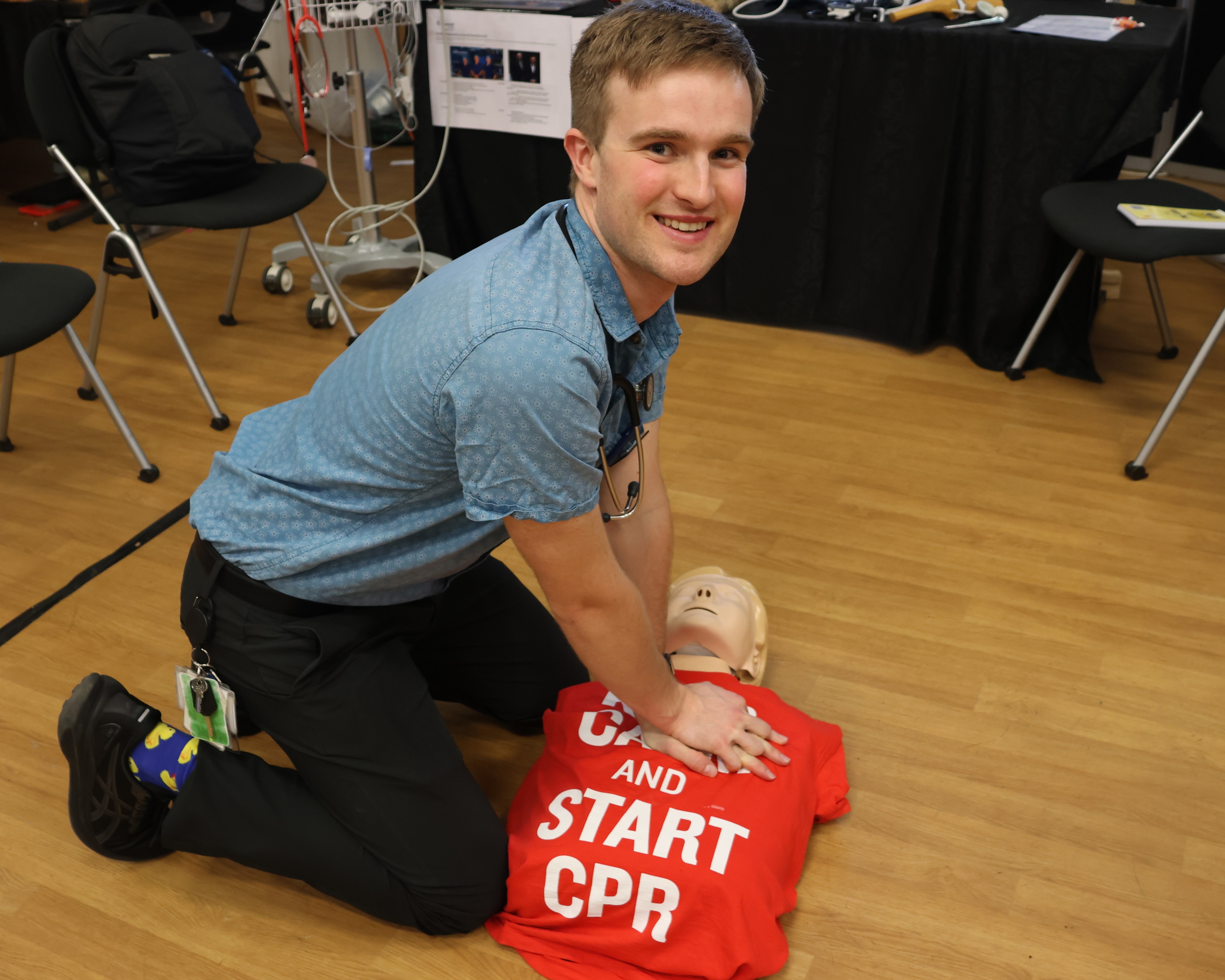
Jack Clerke demonstrates resuscitation techniques at the June 12 Future of Work expo. A native Marlburian in his final year of medical school, completing his training locally, he hopes to practice rural medicine in a Top of the South community. Photo: Evan Tuchinsky.
Jack Clerke has a passion for rural medicine. Born in Blenheim, raised near Linkwater, educated at Queen Charlotte College and now back in Marlborough to complete his training, the final-year medical student deeply understands the challenges – and opportunities – for health care in this locale.
“I wanted to come back to Wairau because the Top of the South region is my tūrangawaewae – my place to stand and feel an enduring connection,” he explained. “It’s so nice to see my whanau, my friends, and I just feel like I belong here, that I could make a difference.”
Jack got the chance via a clinical placement from the Dunedin School of Medicine, one of two medical schools in New Zealand … at least for now. The University of Waikato is developing a third accredited institution set to open in Hamilton in 2028, joining the University of Otago in Dunedin and the University of Auckland.
Last Thursday, the Health Ministry announced Marlborough and Nelson would jointly provide practical training for doctors in Waikato’s Graduate School of Medicine. Top of the South was the only South Island region of the five selected to build Community Clinical Learning Centres.
Rural health needs also prompted the ministry to retool the system for clinical placements for the older medical schools.
During his visit to Marlborough on Friday, Prime Minister Christopher Luxon said the programme has “a particular emphasis in supporting provincial New Zealand ... students spend a lot of time out in the regions, where hopefully they’ll build connection and ultimately be a resource for the regions.”
That prospect spurred Marlborough Primary Health, in partnership with Nelson Bays Primary Health Trust, to pursue the new clinical rotations.
Starting in 2029, Marlborough will host eight doctors-in-training from each year’s class, building up to 32 per year. Nelson will accommodate 12.
MPH Chief Executive Beth Tester told Marlborough Weekly that Council is helping with land for the new facility and iwi with housing.
“We have been struggling to get student doctors for many years,” she shared. “When you actually have people in the community, they get settled, their families settle, their kids go to school – they stay.”