
PM directly addresses Marlburians
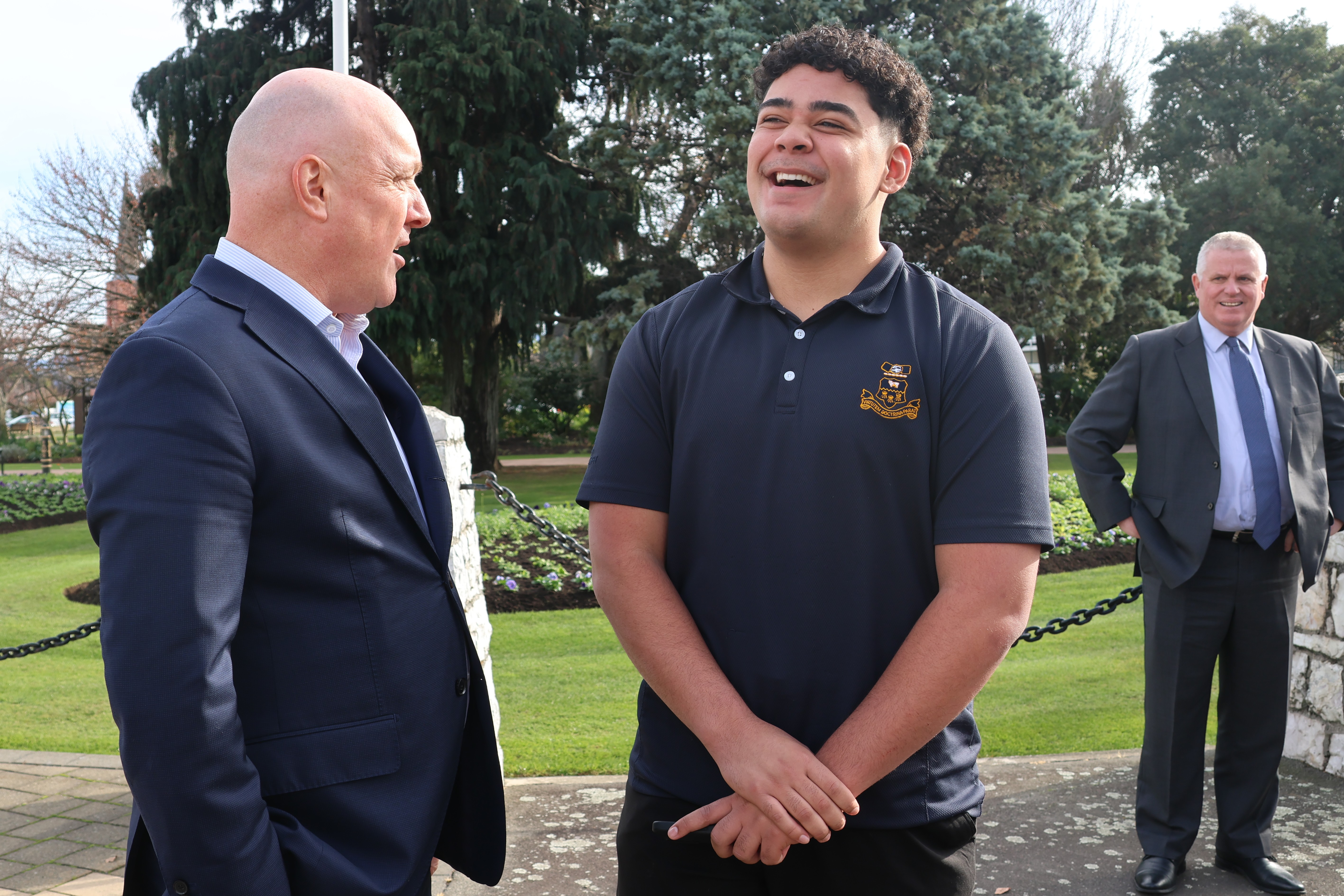
Prime Minister Christopher Luxon talks politics with Lucas Mulitalo at Seymour Square on 12 June. Photo: Evan Tuchinsky.
As if déja vu, Lucas Mulitalo kept turning up during Prime Minister Christopher Luxon’s whistle-stop visit to Blenheim on Friday.
The PM spent part of the morning at Marlborough Boys’ College – where Lucas is a student – and Marlborough Girls’ College.
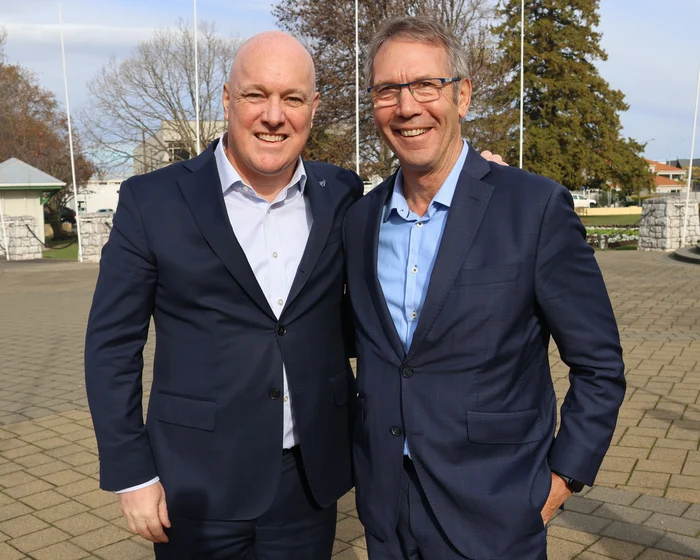
At Seymour Square, where he and MP Stuart Smith met with Marlburian media members, Lucas was there to talk politics. The PM jovially asked what he might do to draw the young man to his side as they calmly debated immigration policy.
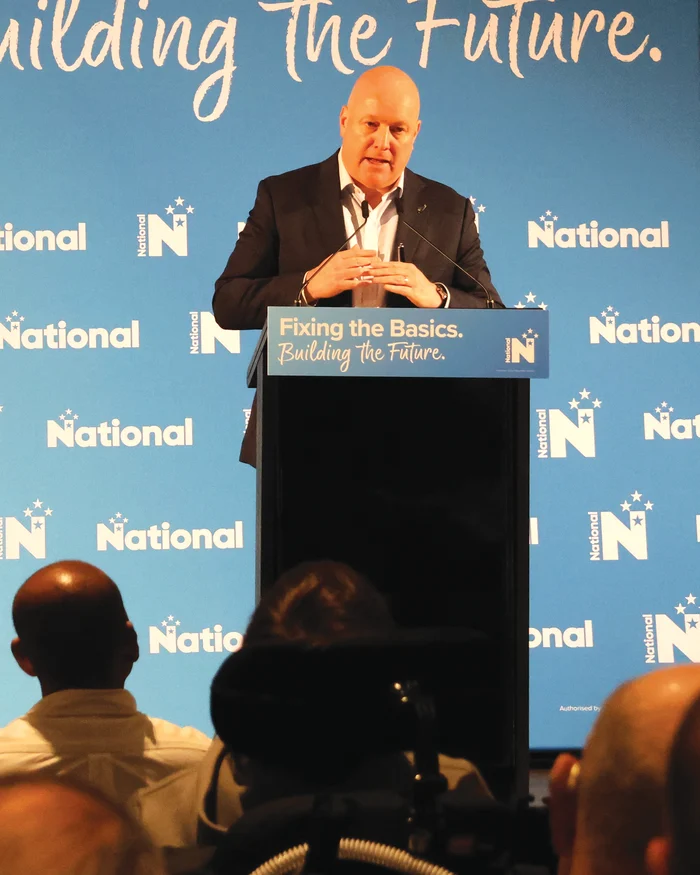
Then, inside Marlborough Events Centre, where the PM addressed about 400 constituents at a National-hosted public meeting, Lucas popped up again in the meet-and-greet queue. The pair recorded a mobile-phone video for one of Lucas’ friends – once more, with smiles.
Their exchanges reflected the response he received, at least publicly. The forum audience reacted politely. Critical questions stayed civil. The only appearance of opposition came outside the venue from a handful of pro-Palestinian protesters.
Councillor and former mayor Gerald Hope – among the half-dozen attendees handed a microphone in the meeting’s Q&A – came away comfortable with what he heard and that he was heard.
“I felt the prime minister was very engaged today,” he replied. “He was well-briefed, and he certainly connected with the audience.
“My personal view is he does understand the need for longer-term planning in New Zealand that actually succeeds – that is cross-party supported, is implemented within the timeframe of a project – and the other thing we need is a longer term of government.”
Talking points
The PM’s speech stated his case for Government policies and plans. He broached crime, education, the economy, Government’s debt load and the budget.
“No doubt, it’s been a difficult few years for New Zealand. … But what’s happening in the world is something quite profound. The world is actually at an inflection point.
“We can’t ultimately control all the global changes,” he added. “[But] we can have a stronger home in a wild storm.”
With the Kaikoura Electorate MP and Waimakariri counterpart Matt Doocey facilitating, the Q&A covered the Paris Accords, hydroelectricity, genetically modified agricultural products, the Resource Management Act, immigration requirements and – the councillor’s concern – the length of government terms.
In the preceding hour, by the War Memorial Clock Tower, the PM took multiple questions from each of the three reporters. Topics spanned the rural medicine programme coming to Marlborough; investment in the region; fuel supplies and prices; secondary education; ministerial expense accounts; and an agriculture package unveiled earlier in the week at Fieldays.
The latter includes $51 million to upgrade farms’ technology and $59 million to buoy sectors including aquaculture, dairy, livestock and forestry. The PM met with backers of a mussel-raising project under Government review.
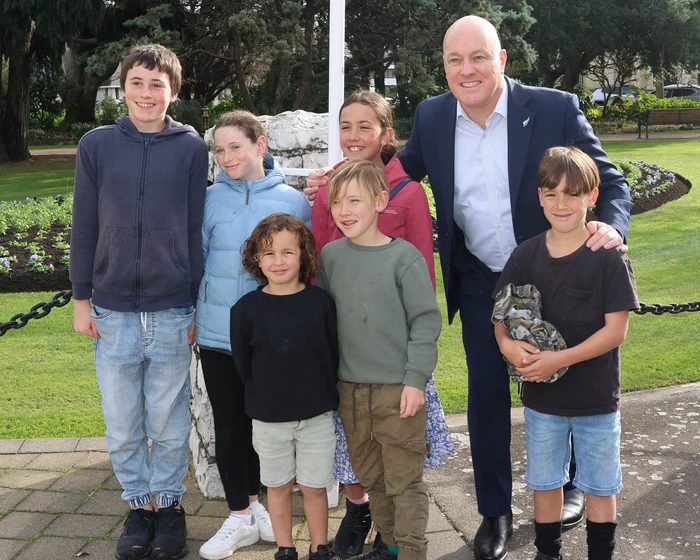
“There is huge global demand for products out of this region,” he noted. “The question is: How do we expand those operations while also managing the sustainability implications?”
Regarding petroleum, the PM pointed to a food-for-fuel agreement with Singapore which, along with South Korea, is “where our big refiners sit”. He continued, “I’m quite confident in the supply side” – and on fuel-price affordability, “over the last five to six weeks, you’ll have seen it come down about 55 cents, diesel in particular, and that’s a good sign”.