
ERA orders sacked Tasman Rugby CEO Steven Mitchell back on payroll

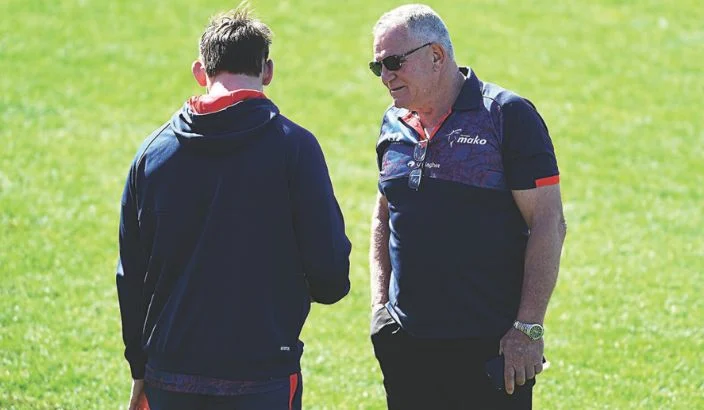
<em>Former Tasman Rugby Union CEO Steve Mitchell, right, at a Mako training session at Trafalgar Park last year. Photo: Chris Symes/Shuttersport.</em>
By Brianna McIlraith, Open Justice
Before a rugby union boss was sacked, his own board members called him “skant” and a “nothing”.
Steven David Mitchell discovered the messages after he had been summarily dismissed in March by Tasman Rugby Union (TRU) for alleged serious misconduct.
Mitchell pursued a personal grievance, claiming his dismissal from his role as TRU’s chief executive was unjustified, and requested internal communications relating to him.
What he received showed board members had discussed him in derogatory terms, including one suggesting he had “cognitive issues from boxing”.
Mitchell has now challenged his dismissal in the Employment Relations Authority (ERA), which has ordered his immediate interim reinstatement to TRU’s payroll only.
Review raised concerns before dismissal process
According to the ERA’s decision, a review commissioned by the board in late November 2025 assessed TRU’s staffing structure, roles and reporting lines, and operational effectiveness.
The review recorded concerns about leadership and visibility, including comments that the CEO lacked “vision, strategy and effective communication” and several staff had “huge concern” about Mitchell’s visible hours.
In an affidavit, TRU board chair Wayne Young said the reviewer had verbally described Mitchell as “missing in action”.
Young sent a formal letter to Mitchell on December 17, 2025, raising performance concerns based on paraphrased review findings and stating that the review had said “leadership must be replaced” when it had said “leadership must be addressed”.
The second half of the letter listed “other concerns”, including claims that Mitchell was “frequently” not at work on Wednesdays and that there was no record he had paid for his wife’s travel expenses for a trip to Southland.
The letter concluded by saying that a decision had not been made but that, subject to Mitchell’s response, “these concerns could potentially amount to misconduct warranting disciplinary action”.
Mitchell responded that he did not agree with all the review findings but took concerns seriously. He said he was willing to meet to discuss when he was back from annual leave over the Christmas break.
The situation escalated when TRU raised a second set of serious concerns in a December 19 letter. These included allegations Mitchell had acted in an intimidating manner towards a staff member, extended staff contracts without permission, and disclosed confidential information.
The letter said “it would be appropriate to suspend you on pay, as provided in your contract, pending the conclusion of this process”.
Mitchell responded through counsel on January 19, disputing the allegations and saying the office conversation related to operational matters and a friend’s death, while the contract extensions were an operational issue for the CEO.
He accepted telling five people that a former TRU chief executive could be joining the organisation, but denied saying he was being “replaced”, and did not accept the proposed suspension.
Mitchell made a Privacy Act request, with the resulting internal board messages not disclosed to him until after his dismissal.
On March 9, TRU proposed summary dismissal, saying the alleged breakdown in trust and confidence left no other available outcome.
Mitchell responded that this was out of range for a “reasonable” and “rational” response.
He was summarily dismissed on March 20.
Internal communications call Mitchell ‘skant’
Mitchell raised the personal grievance for unjustified dismissal and lodged ERA proceedings on April 10, seeking interim and permanent reinstatement, lost earnings, compensation and costs.
The requested communications were not disclosed until April 2, nearly two weeks after his dismissal. They showed board members discussing him in derogatory terms.
One email from board member Tony Healey said Mitchell was referred to by staff as a “skant”. “Old fashioned term but spot on. Google it. Boom,” he commented.
Another message from Young to a board member claiming Mitchell had left work early that day. The board member responded that Mitchell was “the gift that keeps on giving”. Young agreed and communicated that’s “[the reviewer’s] saying too”.
Young also told TRU’s communications adviser he was “still hoping for the nice exit” in which Mitchell would have input.
There was a message from Young to a TRU staff member that included that he had “just arrived back after a big day answering [Mitchell’s] claims/ untruths. I honestly think he has cognitive issues from boxing. After going over my replies it just doesn’t make sense”.
Another board member told Young the process became easier because he had “emotionally cemented” his view and “drawn a line in the sand”.
In an email dated January 21, Healey asked Young “has it gone” then communicated: “Mate. This time in 2 days minus 1 hour. Steven David Mitchell (aka 67. Which means he is a nothing. Ask your kids).”
Young replied with “mate his actions speak volumes – he is showing his true colours”.
Mitchell argued the messages showed board members had formed derisive views of him and were following a predetermined course to oust him. TRU opposed Mitchell’s claims and denied the dismissal process was predetermined.
In her decision, ERA member Antoinette Baker found Mitchell had a “serious case for unjustified dismissal”, particularly his argument that his dismissal was predetermined.
Baker said TRU’s review concerns had merged with later serious misconduct allegations, which “arguably need testing” on both the sufficiency of the investigation and the reasonableness of serious misconduct findings.
She said the board communications showed members had formed personalised views about Mitchell’s “integrity and competence and honesty”.
“I find the overall justice favours returning Mr Mitchell to the payroll immediately on an interim basis,” Baker said.
Baker ordered Mitchell to be reinstated to TRU’s payroll at his CEO salary, including back pay from March 21 as a taxed lump sum.
Dates were being held for a substantive investigation in Nelson in the week beginning October 12, 2026.
