
Service providers reveal realities in Picton
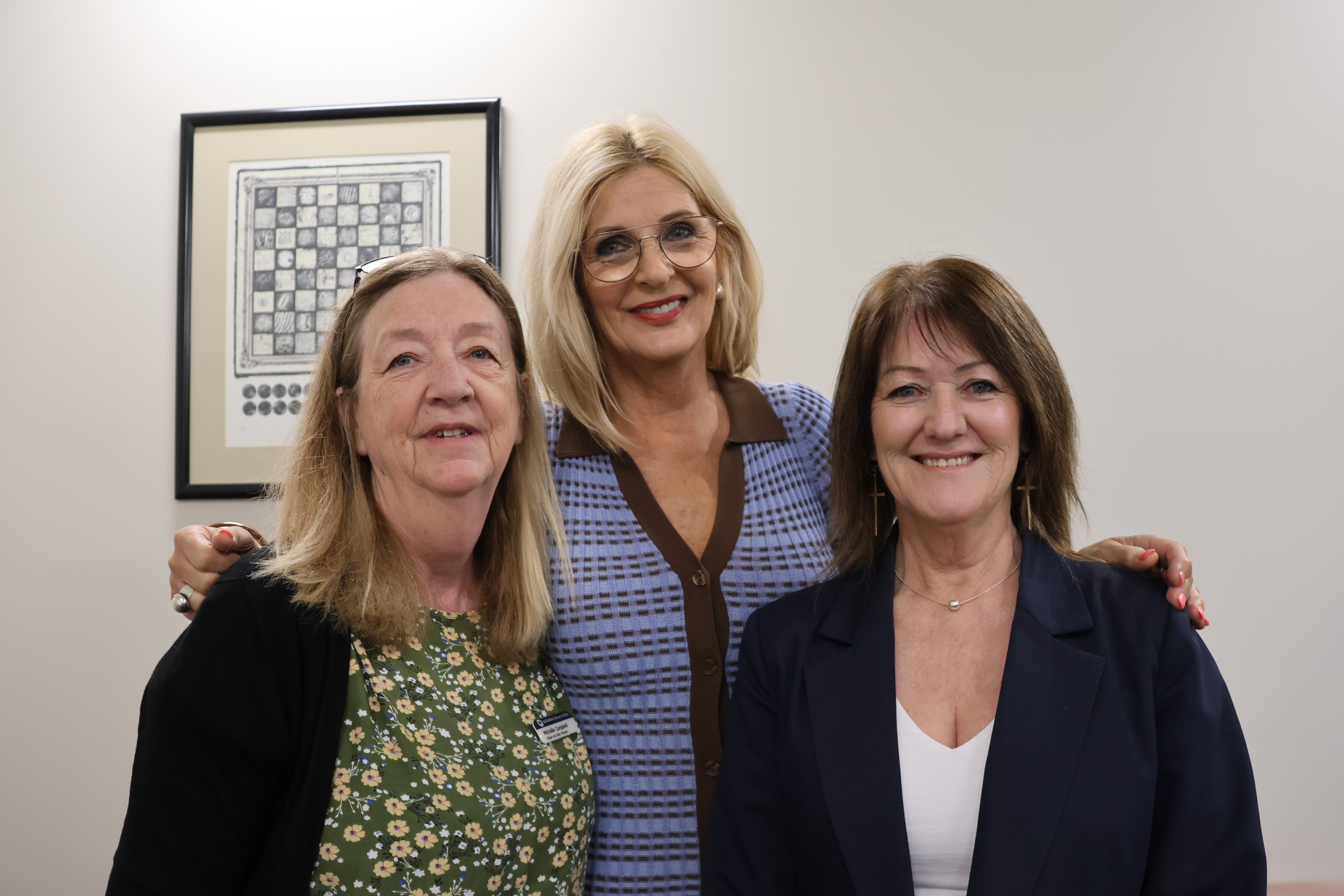
Social services providers Michelle Campbell, left, Marianne Govaerts and Bridget Nolan huddle after speaking to Council on 17 July about poverty in Picton. Photo: Evan Tuchinsky
“When most people think of Picton, they think of a beautiful seaside town … but behind that postcard image is another Picton.”
That Picton, described by social services provider Marianne Govaerts in an address to Council, sees daily battles with poverty, health crises, mental health crises, addiction, homelessness, trauma and crime – sometimes all with a single individual.
The people suffering in these circumstances “are left waiting months for the help they desperately need, and it never comes”. Picton, she stated, “has a wound that keeps getting covered with sticky plasters. That wound is getting bigger, and we are running out of sizeable plasters!”
Marianne, manager at the St Vincent de Paul charity store, came to Thursday morning’s public forum with Bridget Nolan, social worker and team leader from the Salvation Army, and Michelle Campbell, manager of Marina Cove and the Sounds Souper programme.
Their presentation set the scene with stark clarity. They provided specifics about needs their organisations try to meet – and cannot always do so. As Marianne noted, the amount of needs and the needy are growing: St Vinnie’s already has given $65,700 in aid this year compared with $34,500 over all of 2024.
“We are not a social service,” she said. Yet, “the community is becoming more reliant on us as a social service.”
Reflections
After enlightening the councillors and an audience which included MP Jamie Arbuckle via videoconference and MP Stuart Smith’s staff in person, the three women continued the discussion outside of chambers.
Addressing the issues involved falls on Central Government in tandem with local government. “Big changes need to come because we’re at a crisis point,” Marianne stressed, with Bridget and Michelle nodding in agreement.
Picton faces challenges which differ from elsewhere in Marlborough, if not New Zealand. About half of the afflicted people are transients, delivered to the doorstep by ferries. Once they land, transportation to the focal point for many services, Blenheim, is often out of reach.
Almost everyone sleeping outside in Picton has mental health issues; self-medicating with alcohol and/or narcotics comes as a consequence. “If we peel those layers back,” Bridget added, “we’re talking about unhealed trauma.”
Councillors asked for statistics to augment the accounts.
Volunteers have a hard enough time providing services, let alone prying information from people not always eager to divulge. Bridget pointed out how “there’s that evidence” of needs “but they’ve invisible-ised themselves.”
Michelle encapsulated the message by observing: “We’re not a suburb. We’re an amazing town with amazing people who deserve everything that everyone else has coming.”