
Swan strong
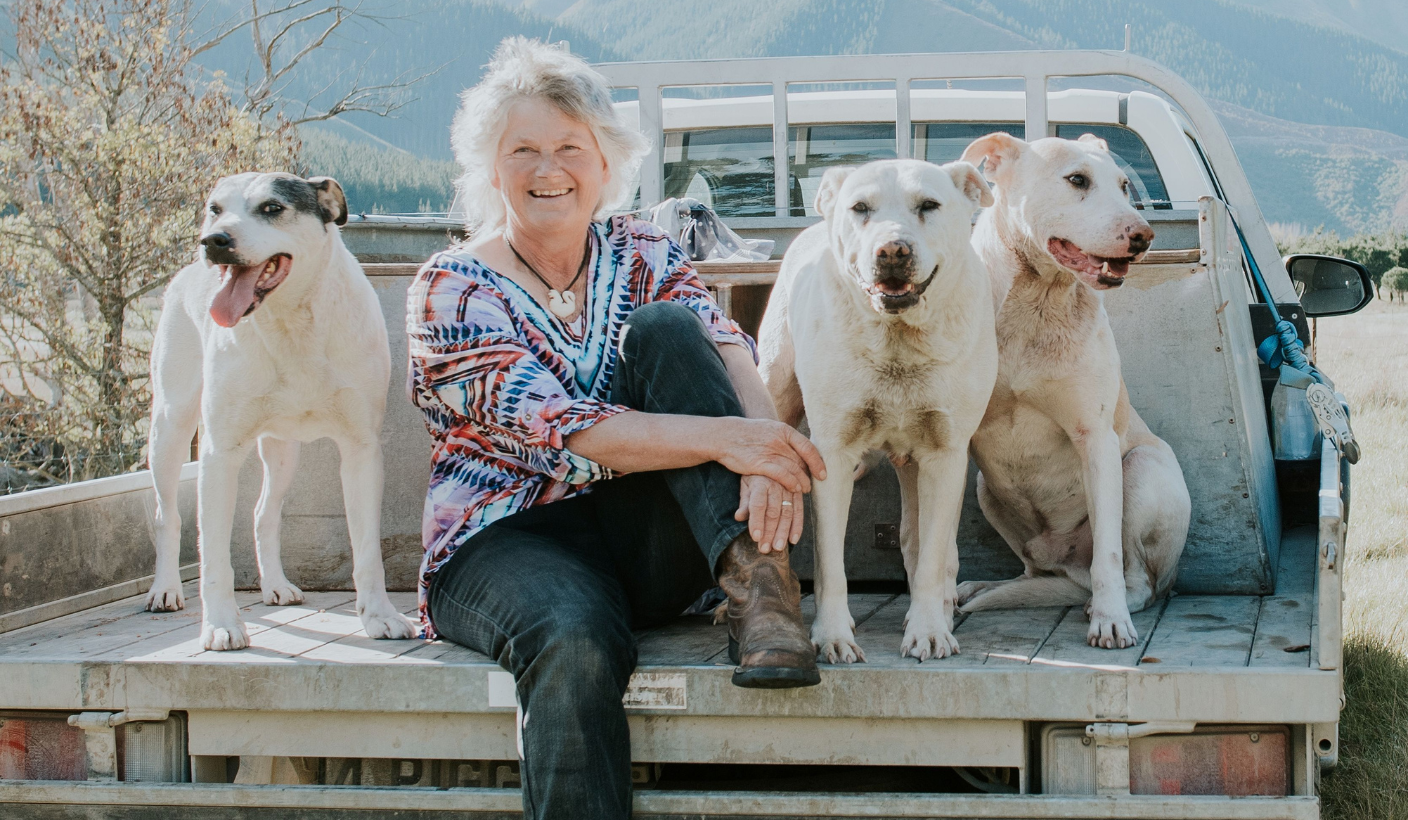
Kim Swan with her pig hunting dogs, trusted partners in the bush for the lifelong hunter.
Kim Swan has been a lifelong hunter, writer and moment-seizer whose working days have been spent far from the conventional office life. She talks to Britt Coker about a hunting life that began before she could walk, of her deep appreciation for dawn’s first rays and the light of the silvery moon.
Photos: Aimée Preston
Most of us are townies. Some of us spend our weekends going bush, but Kim Swan lives and breathes it. She spends her working days as a silviculturist undertaking tree stewardship, biodiversity protection and environmental monitoring. But she’s a long-time hunter too, first strapped to her mother’s back for a hunt when she was 2 weeks old. Probably slept through the safety briefing. Her parents were also “fishers, divers, yachties, everything you can think of outdoors, they were doing it. My maternal grandparents were very adventurous.” Her mother did her first solo pig hunt (with dogs) when she was just 9 years old, Kim did hers when she was eleven. So she is following footsteps, DNA as well as prey. Her son is also a professional hunter and Kim expects her young grandson will one day connect deeply with the backcountry too.
Kim has also written ten books, eight of them about hunting, and has a monthly column in The Fishing Paper & Hunting News. Full of short stories about her experiences in the bush, her books have found an audience with hunters of all ages, but it’s young men, particularly those who have never found reading a worthy pastime, that have become avid page-turners thanks to the subject matter.
“Over the years, my books have been used fairly regularly in schools for teenage boys and things like Reading Recovery classes, partly because of the short story aspect of it. The language is fairly simple, but just because it is something that appeals to – not all boys, by all means – but some young boys where other books in the education system don't hold any interest for them, and so they can relate to it, because it’s an interest.”
“The books will typically be based around hunting, not necessarily pig hunting. I enjoy deer stalking, and I do night shooting, pest control of possums, hunt goats and all sorts of things. So there’s a bit more variety. But typically, the stories will be some wee thing that I find a little bit remarkable. More often than not, it'll be something that I've done wrong, or just something where I can laugh at myself and others can do the same thing.”
A teacher-friend who works with prisoners also uses Kim’s books to incentivise reading in prison programmes for inmates. The ability to read for most of us seems ordinary and universal, which is why not being able to weighs heavily on the self-confidence of those who can’t. The pair agreed it would be a good idea to go out on a hunt together.
“It was just completely alien to her. She was taken aback, perhaps, but it meant that when she is working in the prisons, she could say, I've been pig hunting and tell them her funny stories, that sort of thing. It forms a connection. And the guys will have a laugh with her and open up about their experiences and it sort of goes on from there.”
What do we imagine is the personality of the average, fearless huntress? Some aspect of Xena Warrior woman, broadsword and battle cries perhaps. But I detect no aura of headstrong ruthlessness in Kim. In fact, she is quite the opposite, softly spoken and unassuming.
“I’m nothing special,” she says.
Maybe. But one of us will track a wild boar for hours, strap its body to our back and carry it a great distance out of the bush, and the other one of us will never do that. Kim is 62. Her knees aren’t what they used to be but there is no mention of quitting.
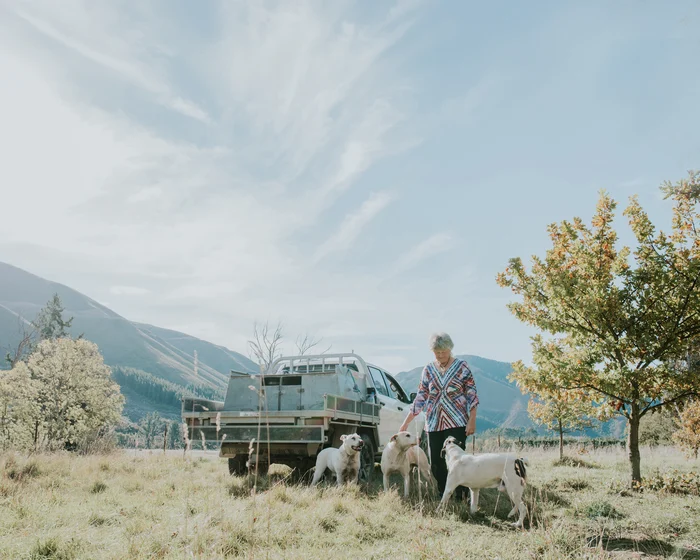
“For me personally, it’s quite often really challenging. And you know, for one reason or another, it’s a big distance, it’s very physical, or what I catch is difficult to retrieve, because I hunt alone. I don't hunt with company.”
Solo hunting, because she can go at her own pace and make decisions to suit only herself, is the reasoning, such as when to go on or give up. I nod in agreement. I’m the same way about op-shopping.
I met Kim on a plane when she was heading to a competition as part of an all-women Marlborough dragon boat team, called ‘Simply The Breast’. Research has shown that the paddling required for the sport is also a beneficial exercise for minimising the occurrence of lymphoedema among breast cancer survivors. Though it’s not an experience Kim has gone through personally, when she heard that the team were looking for more crew, her altruism, her natural inclination to be outdoors, be active and try new things, saw Kim sign up. Dragon boating is not complicated, she says, the age range of the female crew is between 14-84. A mixture of cancer survivors, supporters and sporty women together putting their backs into it. New members welcome.
“I thought, I’ll go and have a crack at something different. See what it’s like, see what the people are like. And I went and had a go and the women were amazing. Paddling was great. It appealed to me because it was upper body whereas most of the stuff I do is lower body workout. It sort of progressed from there. I went very, very quickly from going for my first paddle to going to my first regatta, and I think it was only within six weeks that we were at Nationals. And at the time the world was going through Covid, or from memory for whatever reason there was very little sport all across the world. So my very first nationals were televised all over the world and it was quite mind boggling.”
She had been an endurance horse rider for years where it’s a feat to get to the top level. Then she jumps in a dragon boat a couple of times and she ends up on the telly. Timing is everything.
Not that Kim watches TV. In the evenings, she’ll read a book or play Scrabble. She has a husband (Poss) who she presumably asked to be at the other end of the playing board the first couple of times, and he declined.
“I play Scrabble by myself, just to keep my brain active, I don’t score against myself or anything [because that would be crazy]. My goal is to get to the end and have used up all the letters, similar to playing with other people. I know that sounds ridiculous, but it's just really, really good for my brain.”
I’m also guessing writing ten books and a monthly column for a hunting and fishing paper helps with cognitive abilities, but perhaps by her standards, the infrequency of the writing means they don’t count.
Kim says she’s not that fussed on conventional holidays but prefers solar and lunar cycles like the solstices and equinoxes and does note ‘bite times’ in case her fishing can align with the moon. She has a soft spot for the luminaries.
“I'm not a big fan of – I’m going to say commercial holidays, such as Easter and Christmas – but I’m a big fan of natural things to celebrate, such as the equinox and shortest day, longest day, that type of thing. So quite often on the longest day, for example, I’d put in a couple of months of training before and jump on my bike [bicycle] and ride a couple of hundred kilometres or something. It just goes back to that pushing yourself and celebrating that day by doing something a bit more remarkable than your everyday.”
“My world is being out in the environment and working with, and of, our nature. This sort of knowing. I think there’s a heck of a lot of people have no idea when it’s full moon, just all those sorts of things. There’s so many people who don’t actually get to sit outside at night and look at the stars, or who are up early enough in the morning in the summertime to see our amazing sunrises. I think there’s nothing more a celebration of life than being up early enough and watching the first rays of sun come over the horizon. Being able to see what sort of a day is going to roll out ahead of you. We live in an awesome, awesome country. I just pretty much love every part of it.”
What do you think that connection to nature has given you? “Maybe an appreciation of life and death in the natural world. Maybe more of a connection even to animals, wild animals in particular. A lot of people think hunters are just killers, doing nothing but satisfying bloodlust. It couldn’t really be further from the truth in most cases.”
She uses the expression, ‘pushing yourself’. This seems to be a mindset adopted by Kim, consciously or otherwise. When the body is not engaged, the brain is. This is a woman who at 62 maintains a physically demanding full-time job, then spends her spare time, among other things, hunting in rough terrain, deep sea fishing, dragon boating, long distance cycling, observing 5am sunrises and being a professional writer and amateur scrabbler. There are no flies on Kim. As if we don’t know how it would end for them if there were.