
CarbonScape reshaping energy landscape
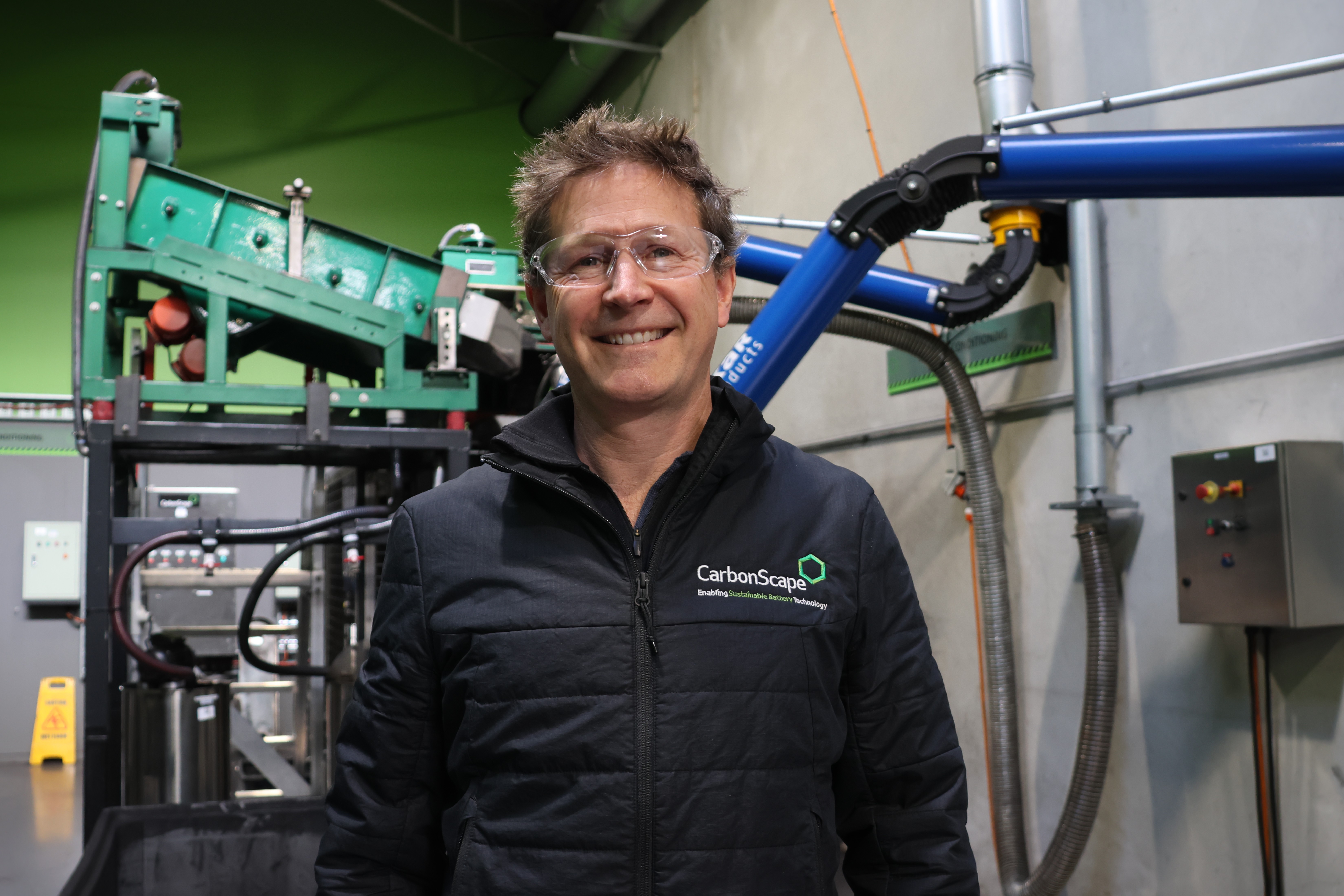
CarbonScape General Manager Oliver Fosterstands in front of a mill inside the company’s Riverlands facility on 29 July. Photo: Evan Tuchinsky
Like many ideas that shake up industries, the innovation driving CarbonScape seems simple. Lithium-ion batteries need graphite – a lot of graphite. Charcoal yields graphite. Forestry byproducts yield charcoal. Forestry abounds.
Simply put, CarbonScape turns tree debris into graphite.
Were it that simple, though, the firm headquartered in Riverlands would not merit the international attention nor international investment it has received, from the likes of Chinese battery giant CATL and Scandinavian forestry leader Stora Enso.
The graphite in lithium-ion batteries is a far cry from pencil-grade; it is refined to an extent that much of the supply is synthetic, a derivative of petroleum. For a key component of green energy, synthetic graphite depends a lot on fossil fuel.
CarbonScape creates the high-quality graphite by recycling biomass – in less time yet at lower temperatures.
At this point, the process is pilot scale; it needs to become industrial scale. That’s where the partners play big roles. In the meantime, in a relatively inconspicuous facility along Whale Trail, 30 employees perform globally significant work.
“For the last five years, we’ve received a strong endorsement from the supply chain that we’re developing a product that customers will want,” General Manager Oliver Foster explained. “We’re hoping to have that validated within the next six to 12 months.
“We still call ourselves a startup,” he added, though one of the shareholders has used the label “development company”. Oliver described CarbonScape as “a mature startup.”
Local roots
An obvious question for a venture like this: Why here?
Well, CarbonScape started here. Locals came together in 2007 and patented a process that could provide green coke to New Zealand’s steel industry. One of the founders, Tim Langley, still serves on the board of directors.
Oliver, who joined the company 10 years ago, explained that graphite has a market value 10 times greater than coke. CarbonScape pivoted around the time he started and turned a corner five years ago.
The potential is enormous. Graphite constitutes about 50 percent of the mass in a lithium-ion battery. In a phone, that’s 10 grams; in a car, that’s 60-100 kilograms. Industry statistics show 17 million car batteries produced last year alone, and projections indicate a tripling by 2030.
While CarbonScape has one employee in Wellington and one in France, the Riverlands site remains home base and will continue as such even with expansion.
“We looked at moving to Nelson at one point,” Oliver admitted, “but Marlborough is a good place to live, we can attract talent here, and it’s an ideal place to house a world-first technology – and keep it away from others during this development phase, I suppose.”